

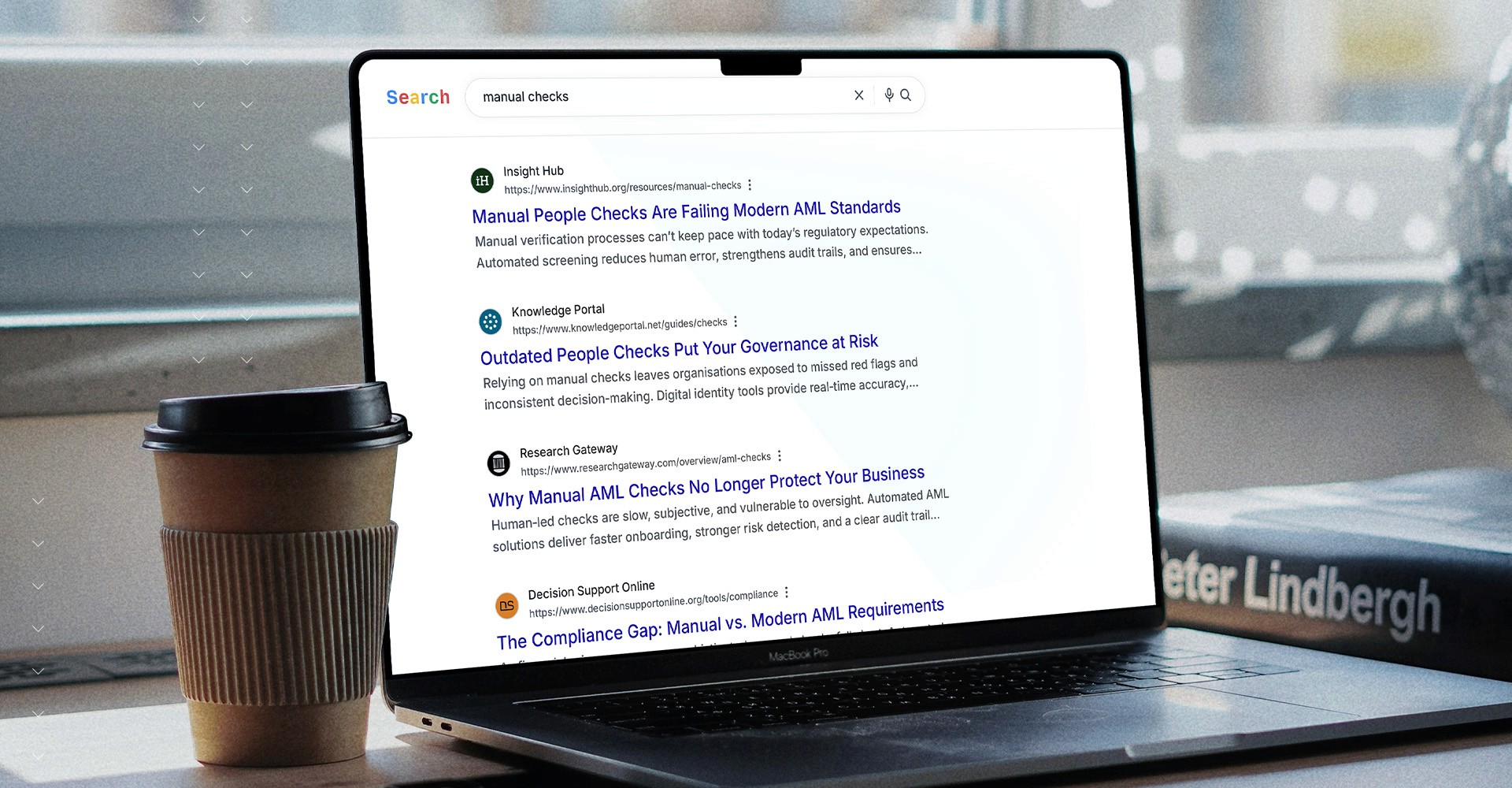
Introduction: Manual Checks Are Failing in 2025
Across Trust and Corporate Service Providers (TCSPs), law firm risk teams and governance functions, many due diligence processes still rely on Google searches, LinkedIn profiles, Companies House lookups and analyst notes.
However, regulatory expectations across AML (Anti-Money Laundering), governance and legal sectors have risen sharply. Bodies such as the Financial Conduct Authority (FCA), Financial Action Task Force (FATF) and Solicitors Regulation Authority (SRA) now expect organisations to conduct structured, consistent, and auditable checks supported by evidence, not disconnected manual searches.
The FCA’s Financial Crime Guide warns that firms must demonstrate effective systems and controls, including traceable due diligence steps.
FATF guidance reinforces this by stating that customer due diligence must be risk-based, documented, and demonstrably thorough.
Most organisations believe their approach is adequate. In reality, manual methods increasingly fail to meet regulatory, legal and governance standards. Manual checks based on OSINT (Open Source Intelligence) workflows are slow, inconsistent and un-auditable, creating hidden liability.
01. The Regulatory Shift: AML, SRA, FCA and Governance Codes Expect More
AML and KYB Requirements (TCSPs, Financial Services, Corporate Services)
TCSPs (Trust and Company Service providers) are legally required to verify directors, PSCs, UBOs and beneficial owners under the UK’s Money Laundering Regulations, with HMRC stating that firms must hold evidence of due diligence and ongoing monitoring.
Companies House’s ongoing Corporate Transparency Reforms further highlight rising expectations for identity verification and data validation.
Legal and Professional Regulation (SRA)
The SRA requires law firms to perform robust, risk-based checks on clients, counterparties and new partners. Weak due diligence and missing audit trails are repeatedly identified as sources of disciplinary action and may soon incur criminal liabilities under proposed reforms by the HM Treasury.
Governance and Board Oversight
Governance functions must meet standards set out in the UK Corporate Governance Code, which stresses the importance of transparent, defensible decision making around board appointments. This same standards are under constant review, with a consultation on centralising fit and proper for AML checks under the FCA, proving oversight to professional body supervisors (PBSs), HMRC, and the legal, accountancy and TCSP firms
The shift is clear: regulators now assume organisations have the ability to access and analyse deeper intelligence than a human can manually compile - and they expect this evidence to be applied.
The reality: bad or incomplete checks create direct regulatory liability for AML-regulated, legal and governance teams.
02. The Four Major Failures of Manual People Research
Failure 1: Fragmented Sources and Missing Depth
Manual workflows typically involve:
Google searches
LinkedIn bios
Companies House profiles
Sanctions list checks
Occasional press searches
However, these cannot uncover deeper insights such as:
Historic or international litigation
Adverse media beyond page one
Hard-to-trace associations
Cross-border directorships
Regulatory actions
Complex beneficial ownership structures
ACAMS (the global AML body) highlights that modern AML checks must incorporate multi-source data correlation, which manual methods cannot deliver reliably.
Meanwhile, manual research rarely covers litigation, adverse media, sanctions, conflicts and associations, all of which regulators expect.
Failure 2: No Audit Trail
Manual checks produce:
Inconsistent notes
Unverifiable findings
No standard format
No traceable evidence
The FCA explicitly requires firms to evidence the basis of their due diligence decisions. Without documentation, regulators assume the work was not done.
Failure 3: Reliance on Unreliable Self-Reported Information
LinkedIn, CVs and nomination packs are self-curated narratives. Research from the CIPD shows that misrepresentation in job histories remains widespread, especially at senior levels.
YOONO's own analysis confirms that self-reported information cannot be relied upon, particularly for regulated appointments.
Additionally, the Harvard Business Review reports increasing instances of senior executives misrepresenting credentials as scrutiny intensifies. The need for sourcing and evidencing individual claims is only growing.
Failure 4: Identity Drift and False Positives
A pressure on multi-source data, common names, inconsistent identifiers and fragmented data lead to:
Misattributed litigation
Incorrect roles or histories
Confused identity matches
Missed red flags due to weak correlation
Regulators expect firms to avoid these pitfalls. FATF guidance warns that beneficial ownership and individual identity checks must avoid false positives and identity confusion, which manual processes cannot guarantee.
03. Real-World Consequences: When Manual Checks Break Down
The failures above are not theoretical. They lead to:
Regulatory penalties
Regulators routinely fine firms for inadequate customer due diligence, poor record keeping and inconsistent AML checks, as highlighted in the UK National Risk Assessment. Enforcement of these penalties is likely to become more common and more severe under proposed government reforms.
Reputational damage
The Guardian and BBC frequently report cases of organisations blindsided by undisclosed conflicts, past misconduct or litigation involving senior hires or business partners.
Failed appointments and deal friction
PwC’s Economic Crime and Fraud Survey notes significant increases in executive misrepresentation, which can derail governance or investment decisions.
Inefficiency and operational drag
Manual research slows onboarding, legal reviews and governance checks, creating competitive disadvantages in fast-moving environments.
Conclusion: Manual Processes Cannot Scale Under Modern Regulation
Regulators, governance bodies and compliance officers now expect checks to be:
Comprehensive
Traceable
Standardised
Repeatable
Evidence-based
Manual research cannot deliver this, automated research through YOONO can:
Deep intelligence in minutes
Multi-source correlation
Identity-matched and risk-ranked findings
Fully traceable, audit-ready reports
Immediate regulatory defensibility
Consistent quality across all checks
Scalable for high-volume workflows.
For TCSPs, governance teams, law firms and AML-regulated organisations, transitioning to automated intelligence is now a regulatory necessity, not an efficiency upgrade.